Many swimming pool owners believe that taking a water sample to a pool store is more accurate than having a professional pool technician test the water at the pool.
It’s an understandable assumption. Pool stores often use computerized testing systems that produce a detailed report with multiple water chemistry readings. However, a digital result does not automatically mean a more accurate result.
The quality of the test, the way the sample is collected, the testing equipment, the reagents, and the experience of the person performing and interpreting the test all matter.
At Waterworx Pools Ltd., we believe professional pool water testing should be about more than simply producing a number. It should help you understand what is happening in your pool and what your pool actually needs.
Professional Pool Water Testing Starts With the Right Equipment
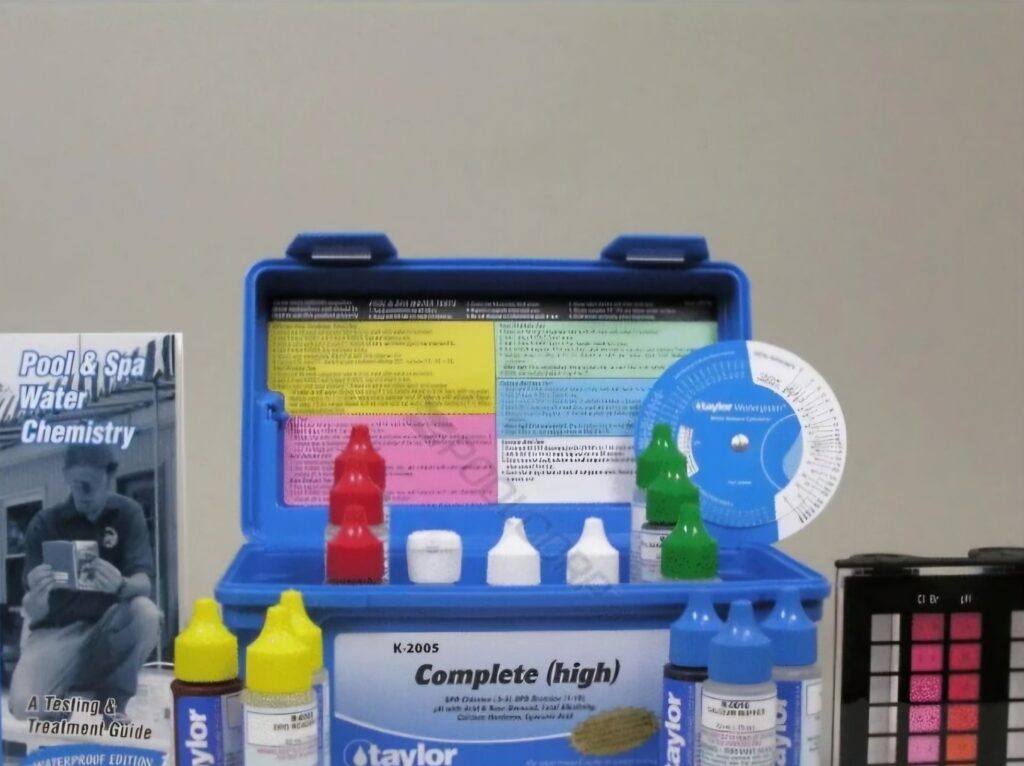
Professional pool technicians commonly use high-quality drop-based testing systems, including Taylor Technologies test kits, which are widely used in the pool and spa industry.
Depending on the test kit, professional testing can measure important aspects of swimming pool water chemistry, including:
- Free chlorine
- Combined chlorine
- pH
- Total alkalinity
- Calcium hardness
- Cyanuric acid
- Salt levels
- Other important water chemistry parameters
These tests can provide reliable results when performed correctly with properly stored and maintained reagents.
But the equipment is only part of the equation.
A good test is only as good as the person performing it.
A trained pool professional understands how to collect a representative sample, follow the correct testing procedure, recognize unusual readings, and interpret the results based on the condition and type of pool.
Why On-Site Pool Water Testing Has an Advantage
One of the biggest advantages of having your pool water tested by a professional at your home is simple:
The water can be tested where the water actually is.
When you collect a sample and drive it to a store, there is a delay between collection and testing.
Certain water chemistry parameters can change depending on factors such as exposure to sunlight, temperature, air, contamination, and time.
Chlorine, for example, is reactive and can change after a sample has been collected, particularly when exposed to light and heat.
Professional on-site testing allows the technician to collect the sample correctly and test it promptly.
That can provide a more representative picture of the pool’s water at the time of service.
Digital Testing Doesn’t Automatically Mean More Accurate
Modern pool stores may use computerized or photometric water-testing systems.
These systems can be useful, and they can provide a convenient way to evaluate several water chemistry parameters.
However, it’s important to understand the difference between precision and accuracy.
A computer may display a result such as 2.3 ppm instead of simply saying 2 ppm. That extra decimal place can make the result look extremely precise, but it does not automatically mean the measurement is more accurate.
Every testing method has its own specifications, limitations and acceptable ranges.
Professional technicians using quality testing equipment are trained to understand those limitations and interpret the results appropriately.
What About Pool Store Chemical Recommendations?
Taking your pool water to a store is certainly not a bad idea. A reputable pool store can provide useful testing and advice.
However, pool owners should also understand how the business model works.
Many pool stores generate revenue by selling pool chemicals and equipment. Some computerized water-analysis systems are connected directly to chemical recommendations and product sales.
This doesn’t mean that every recommendation is wrong—or that pool stores are intentionally selling unnecessary chemicals.
It simply means that pool owners should always understand why a particular chemical is being recommended and whether it is actually necessary.
At Waterworx Pools Ltd., our goal is different: identify what your pool needs and use the appropriate treatment, rather than adding chemicals simply because a computer recommends them.
Pool Chemistry Is About More Than One Number
A professional pool technician doesn’t look at chlorine or pH in isolation.
Swimming pool water chemistry is interconnected.
For example, the appropriate chlorine level depends on factors such as cyanuric acid concentration and pool conditions. pH can affect swimmer comfort, sanitizer effectiveness and the potential for scale formation. Calcium hardness and alkalinity also play important roles in maintaining properly balanced water.
A professional may consider:
- Chlorine and sanitizer levels
- pH
- Total alkalinity
- Calcium hardness
- Cyanuric acid
- Salt concentration
- Water temperature
- Pool usage
- Recent chemical treatments
- Weather conditions
- Water clarity
- Circulation and filtration
This is why professional pool service is about more than testing water and reading numbers.
It’s about understanding the whole pool.
Your Pool Can Tell You a Lot
When a professional technician visits your pool, they can inspect the pool while testing the water.
They can look for issues such as:
- Cloudy water
- Algae
- Scale
- Staining
- Waterline buildup
- Poor circulation
- Dirty filters
- Equipment problems
- Incorrect water levels
- Problems with a salt system or chlorinator
For example, cloudy water doesn’t necessarily mean that you simply need more chlorine.
The cause could involve filtration, circulation, water balance, environmental debris, sanitizer levels, or another underlying issue.
A water test provides valuable information—but experience helps determine what that information means.
So, Should You Test Your Water at a Pool Store?
There is nothing wrong with using a pool store for water testing.
It can be useful, especially if you want a second opinion or access to a different testing method.
However, don’t assume that a pool-store test is automatically more accurate simply because it uses computerized equipment.
A properly performed professional test using a quality system such as a Taylor test kit can provide highly reliable information.
And when the water is tested directly at your pool, your technician can immediately connect the test results with the actual condition of your pool and equipment.
The Best Pool Water Test Is One You Can Trust
Instead of asking:
“Is a pool store test more accurate?”
A better question is:
“Who is performing the test, how is the sample collected, what equipment is being used, and does the person understand pool chemistry?”
Accurate pool water testing is a combination of:
Quality equipment + proper testing technique + correct sampling + experience + professional interpretation.
At Waterworx Pools Ltd., we believe you shouldn’t have to guess what your pool needs.
Our professional pool technicians can test your swimming pool water on-site, assess the overall condition of your pool, and provide practical recommendations based on the actual needs of your water and equipment.
Professional Pool Water Testing in the Fraser Valley
Whether your pool needs routine maintenance, water balancing, troubleshooting, or a professional second opinion, Waterworx Pools Ltd. is here to help.
Don’t just test your pool water. Understand it.
Contact Waterworx Pools Ltd. today to learn more about our professional swimming pool maintenance and water testing services.
Frequently Asked Questions
Is a Taylor pool test kit accurate?
Taylor Technologies test kits are widely used in the pool and spa industry and can provide reliable water chemistry results when the appropriate kit, properly stored reagents and correct testing procedures are used.
Is computerized pool water testing more accurate?
Not necessarily. Computerized testing can be useful, but the accuracy of any testing method depends on the equipment, calibration, reagents, sample collection and testing procedure. A digital result is not automatically more accurate simply because it is produced by a computer.
Is it better to test pool water at home or at a pool store?
On-site professional testing has the advantage of allowing the technician to collect and test the water at the pool, reducing delays between sampling and testing. It also allows the technician to inspect the pool and equipment while evaluating the water chemistry.
How often should swimming pool water be tested?
Testing frequency depends on factors such as pool usage, weather, sanitizer system and water chemistry. Regular testing is important because pool chemistry can change over time.
Can a pool water test tell me everything about my pool?
No. Water chemistry is only one part of proper pool maintenance. Filtration, circulation, sanitation, equipment condition and the physical condition of the pool should also be considered.
Waterworx – Clean Water . Safety First
Copyright ©️ / Waterworx-pools.com – All Rights Reserved –